
Every pool comparison chart shows the same three columns and the same polite tie. Here is the version with an opinion: the three pool types are not three grades of the same thing, they are three different bets about the next thirty years. Concrete bets on permanence, fiberglass bets on convenience, vinyl bets on price. In Connecticut, the winters vote too.
Key takeaways
- Concrete (gunite or shotcrete) is built in place in any shape and is repairable layer by layer for 50-plus years.
- Fiberglass arrives as a factory shell: fast install, smooth surface, but the shape menu is fixed and late-life repairs are narrower.
- Vinyl is the lowest entry price with a liner that is a scheduled consumable, typically replaced on a 7-to-12-year cycle here.
- The honest question is not which is best; it is what year 15 looks like in your yard and your budget.
Concrete: built in place, renewable forever
A concrete pool, gunite or shotcrete, is sprayed over steel in your yard, in whatever shape the design calls for: tanning ledges, integrated spas, vanishing edges, or a simple rectangle done exactly to your dimensions. The structural shell commonly outlives its financing by decades, and every layer on it, finish, tile, coping, deck, is renewable.
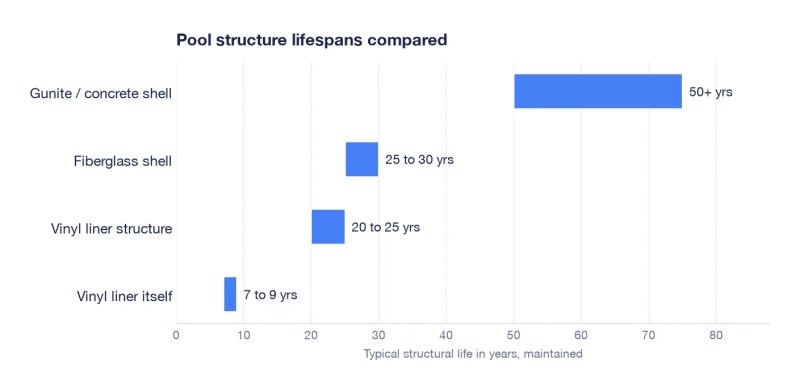
The costs are honest too: the highest upfront price of the three, the longest build, and a finish that wants renewal every decade or two. Concrete is the pool you buy once and maintain forever, which is either the whole point or the dealbreaker depending on your plans.
Fiberglass: the shell on a truck
Fiberglass pools are molded in a factory, trucked to your yard in one piece, and craned into a prepared hole. Install speed is the headline: swimming in weeks, not months. The gelcoat surface is smooth, kind to feet, and slow to grow algae. For a straightforward yard and a shape on the menu, it is a genuinely good product.
The constraints are structural to the idea. The shape list is the shape list, the shell width has to survive the highway, and when the gelcoat ages or blisters at year 15 or 20, refinishing options are narrower and pickier than resurfacing concrete. Fiberglass also floats: an empty shell in a wet Connecticut spring is a real hazard, which complicates the very repairs that need a drained pool.
Vinyl: the price of entry, on a schedule
Vinyl liner pools win the first bid on price, and a well-built one over steel or polymer walls is a fine swim. The liner itself is a consumable: sun, chemistry, and winters retire it roughly every 7 to 12 years in this climate, and each replacement is a real invoice. By year 20, owners are usually weighing another liner against the walls and track that are also aging underneath it.
What Connecticut winters do to each
| Winter reality | Concrete | Fiberglass | Vinyl |
|---|---|---|---|
| Freeze-thaw on the structure | Handles it when joints and water are managed; every part repairable | Shell flexes and copes well; fittings and surrounds age | Liner and track are the weak points; ice is unkind |
| Closing discipline required | High; joints and water level matter | Moderate | High; water chemistry and level protect the liner |
| Spring damage repairability | Any damage has a repair path | Gelcoat and crack repairs are specialized | Liner damage usually means replacement |
The year-15 test
Stand in year 15 and look around. The concrete pool needs its first or second finish renewal, priced and normal, and looks current because you have reshaped nothing but renewed everything. The fiberglass pool still swims well if the gelcoat has held, but its first real surface problem is a specialist repair, and the shape you chose in a catalog is the shape you have. The vinyl pool is on liner number two and quoting number three.
None of those outcomes is wrong. They are different purchases. Our renovation calendar is the tell: most of what we restore is concrete, because concrete is the one you can restore at 40 and 50 years old, and people do.
The GS Rose position
We build gunite because we are masons and it is what we would put in our own yards. But if your budget, timeline, and yard point at fiberglass or vinyl, we will say so and step aside. A pool type sold against its fit becomes someone else’s renovation story.
Weighing pool types for your yard?
Call and describe the yard, the slope, and the wish list. We will tell you what fits, including when the answer is not us.
Free download: the pool type decision sheet
Concrete, fiberglass, and vinyl on one page: shape freedom, lifespan, winters, repairs, and the year-15 reality for each.
Frequently asked questions
Which is better, a concrete or fiberglass pool?
Neither is better in the abstract. Concrete wins on shape freedom, structural life, and repairability; fiberglass wins on install speed and surface smoothness. The right answer is the one whose year-15 reality you prefer.
Are fiberglass pools good in cold climates?
Yes, generally. The shell flexes with freeze-thaw well. The cautions are around draining, since an empty shell can float in high groundwater, and around late-life gelcoat repairs.
How long do vinyl liner pools last?
The structure can run decades, but the liner is a consumable, typically 7 to 12 years in New England. Budget for replacement liners as scheduled maintenance, not surprise repairs.
Why are concrete pools more expensive?
You are paying for in-place construction: excavation, steel, sprayed concrete, cure time, and finish work, plus unlimited shape freedom. The premium buys the longest structural life and full repairability.
Can you convert a vinyl pool to concrete?
Sometimes, and it is a real project: the liner and often the wall system come out, and a new shell gets engineered in the footprint. It is closer to a rebuild than a swap, and worth a site visit before anyone quotes it.
Leaning concrete for the long haul?
GS Rose Construction builds gunite pools across Connecticut, shaped to the yard instead of the catalog. Estimates are free.
Request an estimate