
Gunite is concrete sprayed through a hose over a cage of steel rebar. That is it. The magic is in what that lets you do: build a monolithic concrete pool shell, in place, in any shape, with no seams and no liner.
Key takeaways
- A gunite shell is one continuous reinforced structure, shaped in place. No seams, no liner, no mold.
- The shell commonly runs 50 years and more. The finish you swim against is the wear layer, renewed every 7 to 25 years.
- Gunite handles New England freeze-thaw well because every part of it can be repaired and renewed.
- Most of the gunite work in Connecticut is not building new pools. It is bringing decades-old ones back.
How a gunite pool goes together
Most of the pools we renovate and every pool we build in Connecticut is gunite or its wet-mix cousin, shotcrete. If you have always called these concrete pools, you are not wrong: both are ways of spraying one. The build sequence explains almost everything about why these pools last, so here it is in order.
Dig and plumb
The hole gets dug to the exact shape of the design, and the plumbing gets run: suction lines, returns, main drain, and anything the spa or water features need.
Steel
A grid of rebar gets bent and tied into the shape of the pool, floor and walls both. This cage is what makes the shell a structure instead of a shape.
Spray and carve
A crew sprays concrete over the steel at high velocity, compacting as it lands, then carves it smooth by hand. What cures is a single monolithic shell bonded to the earth.
The wear layers
The finish you swim against, plaster, quartz, or pebble, goes on later. So do the waterline tile and the coping. Those are the renewable parts; the shell underneath is the permanent one.
How long it all lasts
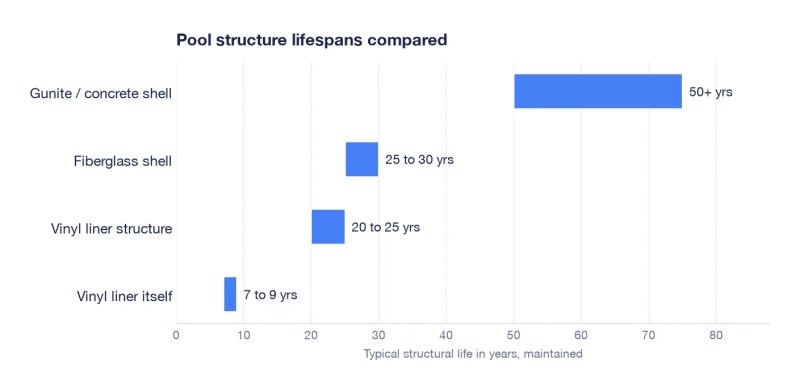
That chart is the honest pitch for gunite. The shell commonly outlives the mortgage, the roof, and sometimes the owner. What you maintain is the wear layer: finishes run 7 to 25 years depending on material, tile and coping run decades when their joints stay sealed.
The corollary matters just as much: when a 30-year-old gunite pool looks rough, the roughness is almost always in the wear layers, not the structure. That is a renovation, not a teardown.
The real pros and cons
| Pros | Cons |
|---|---|
| Any shape, any depth, spas and ledges built in | Highest upfront cost of the three pool types |
| Structural life measured in decades | Longest build timeline, and CT weather gets a vote |
| Every part is repairable and renewable | Finish needs renewal every decade or two |
| Handles New England freeze-thaw when detailed right | Surface is firmer underfoot than vinyl |
The GS Rose position on pool types
If you want a custom shape, an integrated spa, or a pool that outlives its financing by decades, gunite is the answer. If you want the fastest, cheapest swim, a different pool type may fit better, and we will say so. We renovate more gunite than we build, and that is exactly why we trust it.
How the choice plays out against fiberglass and vinyl
On paper the three pool types compete on price. In practice they compete on what year 15 looks like, and that is where the differences get concrete.
Fiberglass arrives as a factory shell on a truck, which makes it fast to install and limits the shape to what fits down the road. It is smooth, low-maintenance, and genuinely good at what it does. Its constraint shows up late: when the gelcoat wears or the shell has a problem, the repair options are narrower, and matching a twenty-year-old gelcoat is its own art.
Vinyl liner is the lowest cost of entry and a fine swim. The liner is a consumable, typically replaced on a cycle, and the panels and track behind it have their own lifespan. In year 20 the question is usually not whether to spend, but whether to keep feeding a structure that was priced for its first decade.
Gunite costs the most up front and gives back the widest set of futures: reshape the steps during a renovation, add a tanning ledge, retile, refinish, or restore a 1970s pool to better than original. Every layer has a repair path. That is the property that makes 50-year-old gunite pools a normal part of our work instead of a curiosity.
The Connecticut angle
Freeze-thaw is the local tax on every pool type. Gunite handles it well for a simple reason: the whole thing is one reinforced structure, and every part of it can be repaired. A vinyl liner tear or a fiberglass gelcoat problem has fewer good answers at year 20 than a gunite pool does at year 50.

A drained gunite shell between lives. If the structure is sound, everything you can see here is renewable.
Owning one has a rhythm to it. The finish gets renewed every decade or two. The tile and coping joints get looked at every season and resealed when they open. The pool gets closed properly every fall, with the water dropped below the returns and the lines blown out. None of it is hard, and all of it is cheaper than skipping it.
Neglect is the only thing that beats gunite
A neglected gunite pool does not fail fast, but it fails expensive. Open joints let water behind the shell, winter does its work, and a finish job becomes a beam job. The details have to be right: joints sealed, water drained away, finish maintained.
Old gunite pool and not sure what it needs?
Call and tell us what you have. We will tell you whether it is a finish problem, a structure problem, or nothing at all.
Free download: gunite pool quick facts
The owner sheet every gunite pool in Connecticut should come with. Service lives, what winter does, and the maintenance rhythm that keeps the shell out of trouble.
Frequently asked questions
What is the difference between gunite and shotcrete?
Both are sprayed concrete over a rebar cage. Gunite is mixed dry and gets its water at the nozzle. Shotcrete arrives wet-mixed. Done well, both build an excellent shell; the crew matters more than the label.
How long do gunite pools last?
The shell itself commonly runs 50 years and more with maintenance. The interior finish is the wear layer and gets redone every 7 to 25 years depending on the material.
Are gunite pools worth the money?
If you want a custom shape, an integrated spa, or a pool that outlives its financing by decades, yes. If you want the fastest cheapest swim, a different pool type may fit better, and we will say so.
What are the downsides of a gunite pool?
Higher upfront cost, longer build time, and a finish that needs periodic renewal. The surface is also harder on feet than vinyl. Those are the honest tradeoffs.
Can an old gunite pool be restored?
Usually, yes. Age alone does not kill a gunite pool. If the shell is sound, new finish, tile, and coping bring a decades-old pool back. That restoration work is most of what we do.
Thinking gunite, new or restored?
GS Rose Construction builds and restores gunite pools across Connecticut. Tell us the yard and the wish list; estimates are free.
Request an estimate