
Two identical-looking pools can get resurfacing quotes thousands of dollars apart, and both quotes can be honest. The number is built from six factors, and understanding them does two things: it lets you read any quote like an insider, and it tells you which factors you control before the bidding even starts.
Key takeaways
- Six factors build the number: size, finish material, surface prep, structural surprises, access, and timing.
- Material choice sets the band: standard plaster is the floor, quartz the middle, pebble the ceiling, with lifespan rising in the same order.
- Prep is the honest variable. What the old surface hides decides more than what the new surface costs.
- The cheapest quote usually thinned the prep line. That is the line the finish stands on.
The six factors that build the number
Surface area
Priced per square foot of interior surface, walls and floor both. A 16×32 rectangle and a freeform with the same footprint can differ; curves add surface.
Finish material
Standard plaster, quartz blends, and pebble aggregates occupy three distinct price bands, and three distinct lifespan bands to match: roughly 7 to 12, 10 to 15, and 15 to 25 years.
Surface prep
The old finish gets chipped, ground, or removed to give the new one a sound grip. How much prep your pool needs is invisible until the water is down.
Structural surprises
Cracks, hollow spots, and delaminations found under the old finish get fixed before anything new goes on. Honest quotes carry an allowance and a unit price for this.
Access and site
A tight backyard, long hose runs, or protected landscaping slow crews and add handling. Easy access is quiet money in your pocket.
Timing
Fall booking rides the calendar’s slack. Emergency mid-season work rides its scarcity.
How material choice sets your band
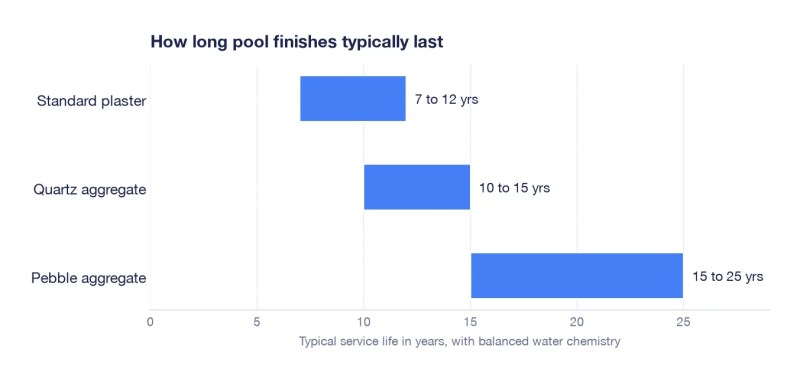
Materials price in the order they last. Plaster costs least and retires first; pebble costs most and runs longest; quartz holds the middle on both counts. The per-year math often flatters the middle and upper bands: a finish that costs half again as much but lasts twice as long is the cheaper pool per season. That is not a sales line; it is division.
We are deliberately not printing dollar figures here. Ranges swing with material markets and with what prep reveals, and any number typed today misleads someone reading this in two seasons. When Greg prices your pool, the numbers come with the reasoning attached, in writing.
The prep truth every low bid hopes you skip
New finish is only as good as what it grips. Proper prep means removing failed material, opening the surface so the bond coat can bite, repairing what the old finish was hiding, and managing water in the shell before anything is applied. It is labor, it is unglamorous, and it is the first line a lowball quote trims. The finish over thin prep looks identical on fill day, and completely different at year three.
The quote gap is usually a prep gap
When two quotes for the same pool sit far apart, line up the prep language side by side: removal versus skim-over, bond coat spec, repair allowances, cure protocol. The delta usually lives there, not in the finish brand.
Reading a resurfacing quote like an insider
| Quote line | What to look for |
|---|---|
| Prep scope | Chip-out or full removal named explicitly, not “prepare surface” |
| Repair allowance | A stated allowance plus unit pricing for surprises beyond it |
| Bond coat | Named product or spec, not assumed |
| Finish spec | Material, brand, and color line, with thickness |
| Water and startup | Who fills, who balances, and for how long; startup chemistry decides cure quality |
| Timeline and cure | Days for each stage, and what weather does to the plan |
What you actually control
Three of the six factors answer to you. Material is your lifespan-versus-budget call. Timing is your calendar call, and fall is the buyer’s season. And surprises are partly a maintenance story: pools that were watched, balanced, and repaired small tend to reveal small things under the old finish; neglected pools reveal projects. The best time to make resurfacing cheaper was five years of water chemistry ago; the second-best time is booking it before the shell starts meeting winter through a worn finish.
The GS Rose position on pricing
We put prep, allowances, and unit prices in writing, and we would rather lose a bid than bury a number. If a quote cannot explain itself line by line, it is not a price; it is a guess with a signature.
Gathering resurfacing quotes?
Call and read us any quote, ours or anyone’s. We will translate the lines and flag what is missing, no charge and no pressure to switch.
Free download: pool quote question sheet
The questions that expose a thin bid, one page, works on any pool quote: resurfacing, remodel, or new build.
Frequently asked questions
How much does it cost to resurface a pool in Connecticut?
It depends on six factors: surface area, finish material, prep needs, structural findings, site access, and timing. Material picks your band; prep decides where in it you land. Ask for the reasoning in writing with any number.
Why do pool resurfacing quotes vary so much?
Usually prep scope. Full removal, bond coat spec, and repair allowances cost real money and are the first lines a low bid trims. Compare prep language before comparing totals.
Is pebble worth the extra cost over plaster?
Per season of service, often yes: pebble typically runs 15 to 25 years against plaster’s 7 to 12. If you plan to stay past year ten, longer finishes usually win the division.
When is the cheapest time to resurface a pool?
Book in fall. The pool is closing anyway, calendars have room, and the finish is ready when the cover comes off. Emergency mid-summer work prices like the emergency it is.
What surprises make resurfacing cost more?
What the old finish was hiding: cracks, hollow spots, and delamination that must be repaired before new finish goes on. Honest quotes carry an allowance and unit prices for exactly this.
Want a number with reasoning attached?
GS Rose Construction prices resurfacing in writing, line by line, across Connecticut. Estimates are free.
Request an estimate