
Coping is the border your hand grabs, your towel lies on, and your eye reads from across the yard. It is also the cap that protects the top of your pool structure. The good news: the four materials that survive Connecticut winters all look good. The better news: choosing between them comes down to three honest questions about feel, style, and budget.
Key takeaways
- Four materials handle CT winters well: natural stone, precast concrete, bullnose brick, and pavers.
- Bullnose refers to the rounded edge profile, not a material; you can get a bullnose edge in almost anything.
- Cool underfoot in July matters as much as freeze-thaw survival in January. Stone and light precast win the barefoot test.
- The set decides lifespan more than the material. A perfect stone on a bad bed fails first.
Natural stone: the New England default
Bluestone and granite are what most people picture on a Connecticut pool, and for good reason. The color belongs in this landscape, the surface stays comparatively cool underfoot, and the freeze-thaw record is the best of the group. Thermal bluestone, with its evened texture, gives bare feet grip without shredding swimsuits.
The tradeoffs are cost, the highest of the four, and weight, which makes the quality of the setting bed even more decisive. Stone coping set well is a decades-long install. Stone coping set on a thin or hollow bed telegraphs every winter through its joints.
Precast concrete: clean lines at a fair price
Precast coping is cast in molds, so every piece matches: same thickness, same edge, same color batch. That consistency reads as a crisp, tailored line around the water, and it pairs naturally with modern rectangles and clean deck designs. It costs meaningfully less than natural stone and takes color better than people expect.
What to watch: the joints. Precast lives and dies by its mortar joints and its bed, and a cut-rate install shows up as popped joints by the third spring. Priced honestly, the material savings should fund the better set, not a thinner one.
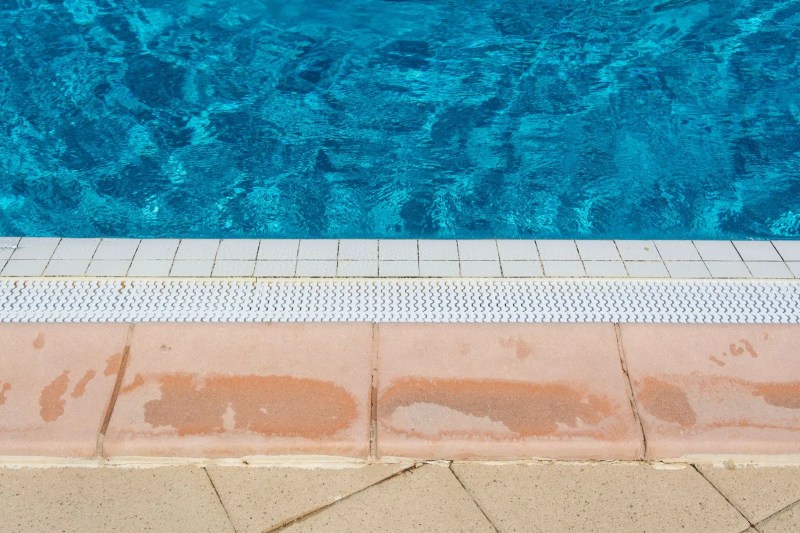
Where the choice shows: the coping line above, the tile band below, and the joint between doing the real work.
Bullnose brick: the classic that keeps its promises
Brick coping with a rounded bullnose edge is all over Connecticut pools built from the 1960s through the 1990s, and plenty of those bricks are still there. The material shrugs off freeze-thaw; it is the mortar joints that age. If you love the look, know that repointing every decade or two is part of the deal, and matching fifty-year-old brick during repairs takes hunting.
Pavers: repairable by design
Paver coping extends a paver deck right to the water, which is exactly why people choose it: one surface, one look, no seam between deck and edge. Individual units also mean individual repairs; one frost-heaved paver lifts out and resets without touching its neighbors. The discipline is edge restraint. Pavers that are not locked at the border migrate, and a wandering coping line is the signature of a rushed install.
A word about edge profiles
| Profile | What it is | Where it shines |
|---|---|---|
| Bullnose | Fully rounded front edge | Comfort; the classic grab-and-hold edge for swimmers |
| Half bullnose | Rounded top, square bottom | Softer look that still reads modern |
| Square or eased | Crisp square edge, slightly softened | Contemporary rectangles and formal designs |
| Rebated bullnose | Rounded edge with a drop face | Automatic-cover pools and raised walls |
People search for bullnose pool coping as if it were a material; it is a shape, available in stone, precast, and brick alike. Pick the profile with your hands and knees in mind, because swimmers hold that edge and kids climb it all summer.
How to actually choose
The barefoot test
Stand on a sample in full July sun. Dark materials on a south-facing deck can get genuinely hot; light stone and precast stay friendlier.
The style match
Coping should agree with the house and deck, not fight them. Colonial and farmhouse yards lean stone and brick; modern builds lean precast and clean profiles.
The honest budget
Price the material AND the set. Whatever you pick, the bed, joints, and pitch decide how many winters it survives. Fund the install, not just the stone.
The GS Rose position on coping choices
On an older Connecticut pool, properly set natural stone or precast beats chasing the cheapest bid. The material is a one-time cost; a bad set is a repeating one. And if your current coping is loose, decide the cause before the upgrade: pretty new stone on a failing bond beam is money rented, not spent.
Torn between two materials?
Call and describe the yard, the house, and the deck. We will tell you what we would set on our own pool, and what we would skip.
Free download: the pool coping material guide
Stone, precast, brick, and pavers compared for Connecticut pools, plus the three things that decide how long any of them last.
Frequently asked questions
What is the most popular pool coping material?
In Connecticut, natural stone leads, with bluestone the regional favorite, followed closely by precast concrete. Both suit the climate and the housing stock.
What is bullnose pool coping?
A rounded front-edge profile, not a material. Bullnose edges are available in natural stone, precast concrete, and brick; the shape is comfortable to hold and kind to swimmers.
What pool coping stays coolest underfoot?
Lighter colors and denser stones stay cooler. Thermal bluestone and light precast perform well; dark materials on south-facing decks run hottest.
Can you mix coping and deck materials?
Yes, and it is often the best move: stone coping over a concrete or paver deck is a classic pairing. The joint between them matters more than the match.
How long does pool coping last in Connecticut?
Set well, stone and precast run decades; brick outlasts its mortar, which needs repointing every 10 to 20 years. Installation quality decides more than material.
Ready to upgrade the edge?
GS Rose Construction sets stone, precast, brick, and paver coping across Connecticut, and checks the beam under it first. Estimates are free.
Request an estimate