
Your pool is losing water and you want to know if it is a leak. Do the bucket test tonight. It costs nothing, takes 24 hours, and answers the question that decides everything else: is this evaporation or is water actually leaving the pool?
Key takeaways
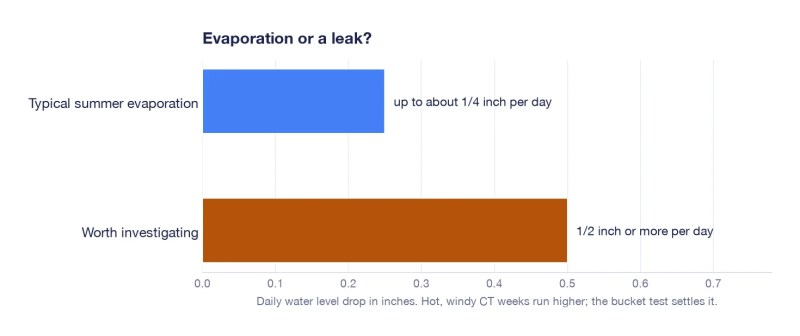
- Up to about a quarter inch of water loss a day is normal evaporation in a Connecticut summer. A half inch or more, day after day, usually is not.
- The bucket test separates evaporation from a real leak in 24 hours, for free.
- Running the test twice, pump off and pump on, tells you whether the problem is in the shell or the plumbing.
- Never carry a known leak into a Connecticut winter. Freeze-thaw turns small leaks into structural repairs.
The bucket test, step by step
Every leak call we take starts with the same question: how do you know it is a leak and not the weather? A pool in East Hampton loses water to the sun and wind just like a puddle does, and a hot, breezy July week can pull a surprising amount off the surface. The bucket test settles it, because a bucket of pool water sitting in the pool evaporates at the same rate the pool does, and a bucket cannot leak.

The top step is your test bench: bucket here, marks on the tile.
Set the bucket
Fill a bucket with pool water and set it on the top step, weighted down with a rock so it stays put. Use pool water, not tap water, so both surfaces are the same temperature.
Mark both levels
Mark the water line inside the bucket and the pool level on the outside of it. Painter’s tape works fine. A grease pencil works better if the bucket will sit in sun all day.
Shut it all down
Pump off. No swimmers, no autofill, no topping off, for 24 hours. An autofill line quietly refilling the pool is the single most common way this test gets ruined.
Compare the drops
The bucket only loses water to evaporation. If the pool dropped the same amount, you are looking at weather and you can stop worrying. If the pool dropped more, water is leaving another way.
Run it again with the pump on
Repeat the same 24 hours with the pump running. If the pool loses noticeably more with the pump on, the leak is probably in the plumbing, because pressure is pushing water out of a line.
Write your numbers down
Start level, 24 hour level, and the drop, for both runs. If the test points at a leak and you end up calling someone, those numbers cut real time off the diagnosis, whoever does the work.
Clues that narrow it down
The bucket test tells you that water is leaving. These four clues tell you where to look next. None of them requires draining the pool or buying equipment, and together they usually point at one of three places: a penetration in the shell, the plumbing, or the structure itself.
Where the level stops. A pool that drops and then holds at a specific line is telling you the leak sits right at that line. Water cannot leak out of a hole it has already dropped below. Check what lives at that height: return fittings, the light niche, the skimmer throat. If the level stabilizes mid-wall, the floor and the main drain are probably fine.
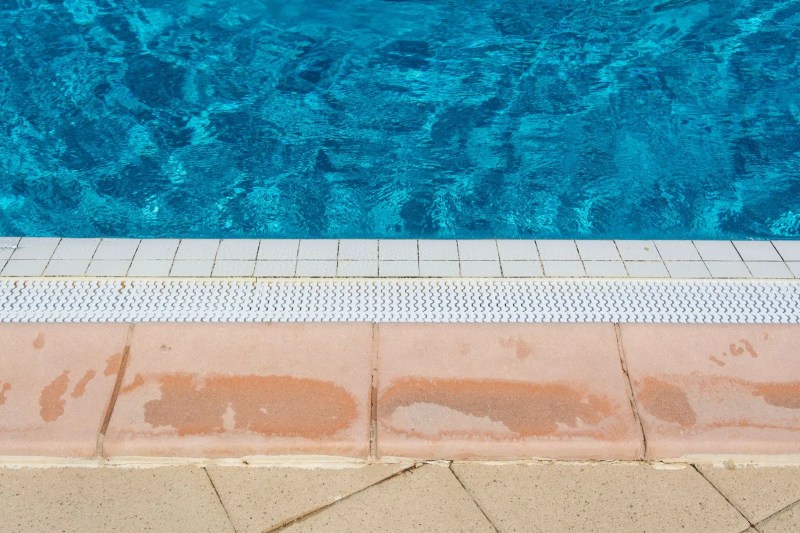
The waterline is where most leaks announce themselves: fittings, tile line, skimmer seam.
Wet ground. Soggy spots in the yard on dry weeks, especially along the run between the pool and the equipment pad, point at buried plumbing. So does a patch of lawn that stays greener than everything around it in August. Underground return lines fail more often than suction lines because they hold pressure whenever the pump runs.
Air in the system. Bubbles blowing back from the returns, or air collecting in the pump basket, mean the suction side is pulling air from somewhere it should be pulling water. That is a plumbing clue, not a shell clue, and it often shows up before the water loss gets dramatic.
The skimmer seam. The joint where the plastic skimmer body meets the concrete shell is one of the most common leak points on gunite pools. Concrete and plastic expand at different rates, and decades of freeze-thaw cycles work that joint loose. A few drops of leak detection dye released at the seam, with the pump off, tell the story in seconds: if the dye gets drawn into the joint, you found it.
Not sure what you are looking at?
Call and describe what you see. We will tell you whether it is worth a visit, and we will tell you if it is not.
What a leak costs you while you wait
A half inch of water a day does not sound like much. On a 16 by 32 foot pool, it is roughly 160 gallons a day, over a thousand gallons a week. Every one of those gallons walks out with your chemicals in it, so you are not just refilling water, you are re-balancing chlorine, alkalinity, and stabilizer week after week. If the pool is heated, the story gets worse: the water leaving is the water you paid to warm, and the cold fill water replacing it makes the heater run longer.
There is a quieter cost too. Water moving through the same path for months erodes that path. A pinhole in a return line becomes a washed-out void behind the pool wall. A seeping skimmer seam becomes a settled skimmer and a cracked deck section above it. Leaks do not heal, and they do not stay the same size. The cheapest leak repair is always the early one.
What you can fix, and what needs a pro
Some of this is honest homeowner territory, and we would rather you handle it than pay us to. Some of it is not, and the line between the two is mostly about what has to be opened up to do the job right.
| You can handle it | Bring in a pro |
|---|---|
| A skimmer weir stuck low, spilling water into the throat | Pressure testing underground plumbing lines |
| An autofill valve masking the real loss rate | Dye testing underwater with proper gear |
| Obvious gaskets on above-ground fittings and pump lids | Anything that means cutting into a shell or a deck |
| Running the bucket test and logging the numbers | Any leak paired with a visible crack in the shell |
The GS Rose position on leaks and cracks
A leak paired with a crack is never just a leak. At that point the question is not only where the water goes but what it is doing to the structure on the way out. We treat that combination as a structural diagnosis first and a leak repair second, because patching the symptom over a moving crack buys you one season, not a fix.
Do not winter over a known leak
This is the Connecticut-specific warning. Water moving through a shell or behind a wall all winter, freezing and thawing dozens of times, is how a small leak becomes a structural repair by spring. If the bucket test points at a leak in September, settle it in the fall, not in May.
Free download: the bucket test worksheet
The five steps, a fill-in table for your numbers, and how to read the result. If the test points at a leak, bring the sheet; your numbers help us find it faster.
Frequently asked questions
How much water loss is normal for a pool?
In a Connecticut summer, up to about a quarter inch a day to evaporation is ordinary, more on hot windy weeks. Losing a half inch or more day after day usually is not weather.
What is the bucket test for a pool leak?
Set a bucket of pool water on a step, mark both levels, wait 24 hours with the pump off. If the pool dropped more than the bucket, the loss is not evaporation.
Where do most pool leaks happen?
Fittings, skimmers, returns, and light niches lead the list, followed by plumbing and, least often, the shell itself. The pump-on versus pump-off comparison points toward plumbing or structure.
Does a leaking pool mean structural damage?
Not usually. Most leaks are at penetrations and plumbing. But a leak paired with a visible crack, or one left running through a winter, can create structural problems, so it is worth settling quickly.
How do professionals find pool leaks?
Pressure testing the lines, dye testing suspect spots, and listening equipment. The homeowner bucket test tells us which direction to point all of that, which saves diagnostic time and money.
Bucket test says it is a leak?
GS Rose Construction finds and fixes pool leaks across Connecticut. Bring your numbers, we will bring the diagnosis. Estimates are free.
Request an estimate